Graveyard

Graveyard
The Matthews Monument at Green-Wood Cemetery, Brooklyn, NY

Sunday, August 21, 2011

Pansies, Poppies and Passion Flowers

While the Victorians had a few most-favorite flowers that they placed on cemetery tombstones (lily of the valley and roses being two of the most popular), they used many types of flowers to symbolize different sentiments to mark the resting place of their loved ones.  And while I haven’t found an abundance of carvings of pansies, poppies and passion flowers, I have discovered a few lovely examples of each of them.

Pansy

To the Victorians, pansies symbolized humility and remembrance.  The history of the pansy is linked to its ancestor, the viola, which originated in Europe.   A delicate and yet hardy bloom, the viola was cultivated by the Greeks for medicinal use.  Sometime after the 4th century B.C., a mutation occurred:  the viola gave birth somehow to a wild pansy, a flower at home in alpine meadows and rocky ledges.  The first sightings of the pansy might have been in France, as its name traces back to pensee, French for thought or remembrance.

Hybridization of the pansy blossomed (forgive me) in the mid-19th century, pansies became a popular flower for Victorian gardens.

Poppy

The poppy, both the flower and the seed pods, represents eternal sleep, peace and rest.  The Greek goddess Demeter, in despair over the seizure of her daughter Persephone by Pluto, ate poppies in order to fall asleep and forget her grief.  

Opium is derived from poppies, and when combined with alcohol derivatives, produces laudanum, a popular Victorian medicine used as a headache and sleep remedy.  Also, numerous household medicines contained opium and were used to treat children, such as Godfrey’s Cordial, commonly given to children and infants as a sleeping draught.  Sometimes, however, overdoses happened, and eternal sleep came sooner than planned.

Passion Flower

The passion flower is a symbol of faith and belief that Christ, through his suffering, was sent to save us. The different parts of the unusual flower of the passion-fruit plant were interpreted by Spanish priests in 17th-century South America to symbolize the crucifixion and the suffering of Christ. The central column of the flower represents the pillar to which Jesus was tied to be scourged. The thread-like inner petals represent the crown of thorns, the five yellow stamens symbolize the five wounds of Christ and the three pink styles represent the nails. The ten outer petals symbolize the ten faithful apostles.  

The Spanish introduced Europe to the passion flower in the 1700’s, and the by the 19th century, it could be found in North America as well.  The Victorians continued to view the passion flower as a symbol of Christ.

Pansies, Riegelsville Cemetery, Rieglesville, PA

Pansies, St. John's Lutheran Cemetery, Honesdale, PA

Poppies, Glen Dyberry Cemetery, Honesdale, Pa

Poppies, Dunmore Cemetery, Dunmore, PA

Poppies, Easton Cemetery, Easton, PA

Poppies, Easton Cemetery, Easton, PA

Poppies, Hays Cemetery, Easton, PA

Poppies, Laurel Hill Cemetery, Philadelphia, PA

Passion Flower, Dunmore Cemetery, Dunmore, PA

Passion Flower, Trumbauersville Cemetery, Trumbauersville, PA

Passion Flower Close-Up, Dunmore Cemetery, Dunmore, PA

Friday, August 12, 2011

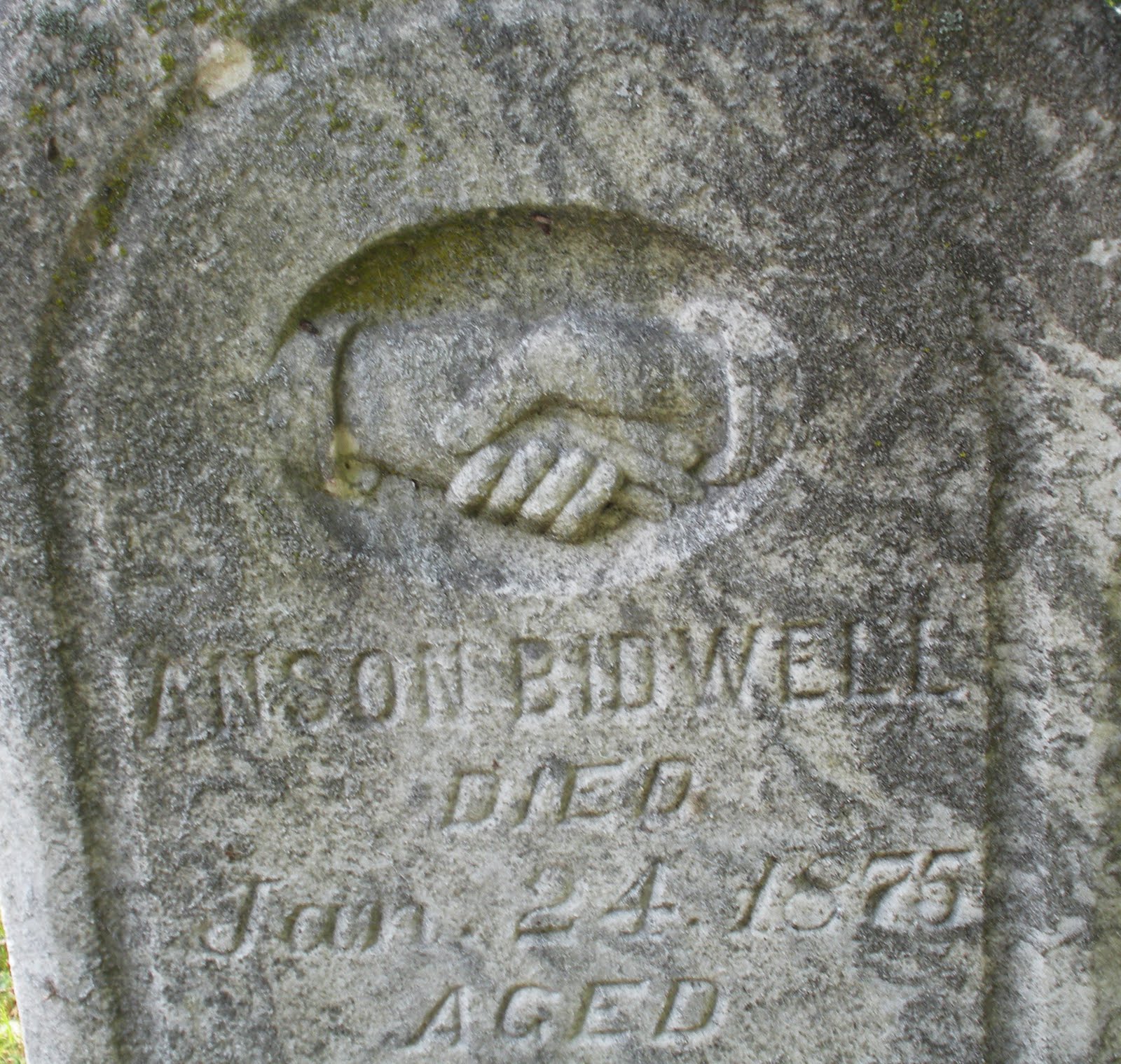
The Final Handshake

Easton Cemetery, Easton, PA


One of the most prolific gravestone carvings of the 19th century was the handshake.  The handshake symbolized the last farewell to those left behind.  I have taken about 100 pictures of handshakes on tombstones in more than 50 cemeteries in mostly eastern Pennsylvania, and without an exception, they all have one thing in common:  they all depict the hand on the right clasping the hand on the left, whose palm and fingers almost always remain flat and open.  (The one above is the only exception--the left hand is clasping also.)  Other internet cemetery symbol sites mention the same pattern, occurring across the country.  (And you thought I was the only gothic nutcase into this, eh?)  This probably represented God, on the right, leading the deceased, with the meek and open hand, to heaven.  

Carved handshakes frequently marked the final resting place of husbands and wives.  It showed that even “death do us part” does not severe the marriage bond.  Many of the carvings show two different cuffs…one decidedly more feminine with lace or a blouse-y drape, one with a suit-coat look.  However, I have noticed that sometimes the gravestones of single adults also had the same carvings---a male hand and a female hand clasped together.  Perhaps the purchaser of the stone just liked the design, or the stone carver sold them on the idea, or it was a popular stock design in the tombstone catalog (even Sears and Roebuck sold tombstones back in the late 1800’s through their catalogs.)

And yet even though every carved handshake has the same basic form, the variations of design amaze me:  stubby fingers, elongated fingers, fat hands, slim hands, nails, no nails, the barest hint of cuffs, elaborately detailed cuffs…it is hard to find two carvings exactly alike.  

The detail that most intrigues me is that some of the carvings---about ten percent of the pictures I have collected---show the right hand with the index finger extended, not clasped around the left hand like the rest of the fingers.  My research has not yielded any definite answers on the meaning.  There are claims that it symbolizes a handshake from a secret fraternal organization such as the Masons or the Independent Order of Odd Fellows (that will be a future blog, never fear).  One source (Remnant Stones, by Viva Ben-Ur and Rachel Frankel) call this “presenting hands,” and argue that it symbolizes “a continuum of being, and even interaction, between above and below, between the living and the dead, and between the human and the divine.”  Maybe.  Did you know that if someone shakes your hand while you extend your index finger like that, they can squeeze as hard as they want but they cannot give you a bone-crushing handshake?  Maybe then, that symbol with the index finger extended does show the supremacy of God over Man…no matter how hard we try, in the end, we die.  And on that cheery note........

Bolkcom Cemetery, Rileyville, Pa

St. John's Lutheran Cemetery, Quakertown, PA

Hornbaker Cemetery, Madisonville, PA

Dunmore Cemetery, Dunmore, PA

Quakertown Union Cemetery, Quakertown, PA

St. Paul's Applebach Cemetery, Applebachville, PA

Glen Dyberry Cemetery, Honesdale, PA

Glen Dyberry Cemetery, Honesdale, PA

Salem Cemetery, Hamlin, PA

Laurel Hill Cemetery, Philadelphia, PA

Laurel Hill Cemetery, Philadelphia, PA

Glen Dyberry Cemetery, Honesdale, PA

Hays Cemetery, Easton, PA

Montgomery Baptist Cemetery, Montgomeryville, PA

Newtown Cemetery, Newtown, PA

Quakertown Union Cemetery, Quakertown, PA

Quakertown Union Cemetery, Quakertown, PA

Quakertown Union Cemetery Close-Up, Quakertown, PA

St. John's Lutheran Cemetery, Honesdale, PA

St. Joseph's Roman Catholic Cemetery, Honesdale, PA

St. Michael's Evangelical Lutheran Cemetery, Sellersville, PA

St. Peter's Union Cemetery, Hilltown, PA

St. Peter's Union Cemetery, Hilltown, PA

St. Peter's Tohickon UCC Cemetery, Keelersville, PA

St. Peter's Tohickon UCC Cemetery Close-Up, Keelersville, PA

Tannersville UCC Cemetery, Tannersville, PA

UPSIDE DOWN HANDS, Dunmore Cemetery, Dunmore, PA

Wentz's UCC Cemetery, Worcester, PA

Zion Cemetery, Newfoundland, PA

INDEX FINGER OUT, Hays Cemetery, Easton, PA

INDEX FINGER OUT St. Paul's Applebach Cemetery, Applebachville, PA

INDEX FINGER OUT, Daleville Cemetery, Daleville, PA


INDEX FINGER OUT, Hollisterville Cemetery, Hollisterville, PA

INDEX FINGER OUT, Madisonville Union, Madisonville, PA

INDEX FINGER OUT, Neola Methodist Cemetery, Neola, PA

INDEX FINGER OUT, St. Michael's Evan. Lutheran Cemetery, Sellersville, PA

INDEX FINGER OUT, St. Peter's Union Cemetery, Hilltown, PA

INDEX FINGER OUT, St. Peter's Union Cemetery, Hilltown, PA

INDEX FINGER OUT, St. Peter's Union Cemetery, Hilltown, PA

INDEX FINGER OUT, St. Paul's Applebach Cemetery, Applebachville, PA

INDEX FINGER OUT, Wentz's UCC, Worcester, PA

MISSING FINGER, St. Peter's Tohickon UCC Cemetery, Keelersville, PA

MISSING FINGER, St. Peter's Tohickon UCC Cemetery, Keelersville, PA

BOTH INDEX FINGERS OUT, Springbrook Cemetery, Springbrook, PA