Graveyard

Graveyard
The Matthews Monument at Green-Wood Cemetery, Brooklyn, NY

Sunday, November 11, 2012

Grateful for Your Service in Flanders and Other Fields


Cold Spring Presbyterian Cemetery, Cold Spring, NJ

How many of us had to memorize "In Flanders Fields," the WWI poem by Canadian poet, physician and solider John McCrae?  I believe it was in the 7th grade when I learned it, and I still know it to this day.  It gives me pause when I think about the words of that poem, because war never seems to really solve anything, and soldiers die for ideas, ideals, ideology.  Kind of a hollow victory in the long run, because some hearts cease to beat, while others left at home break.  But I am truly appreciative of those who stepped forward over the years and defended our country.  To those who came home and died during peacetime, thank you and thank God.  And to those who died during war, know that we will never "break faith" with you---thank you for the greatest sacrifice.


In Flanders fields the poppies blow
      Between the crosses, row on row,
   That mark our place; and in the sky
   The larks, still bravely singing, fly
Scarce heard amid the guns below.

We are the Dead. Short days ago

We lived, felt dawn, saw sunset glow,
   Loved and were loved, and now we lie
         In Flanders fields.

Take up our quarrel with the foe:

To you from failing hands we throw
   The torch; be yours to hold it high.
   If ye break faith with us who die
We shall not sleep, though poppies grow
         In Flanders fields.
---John McCrae

A Resident of Flanders Field, memorialized here, Rosedale Cemetery, Montclair, NJ

Yes, that is my father posing with a gun at Evergreen Cemetery, Jim Thorpe, PA.  Pop served in the Navy during 'Nam. 

A Confederate casualty at Sharpsburg/Antietam.  "A Martyr to the Southern Cause."  Elmwood Cemetery, Shepherdstown, WV

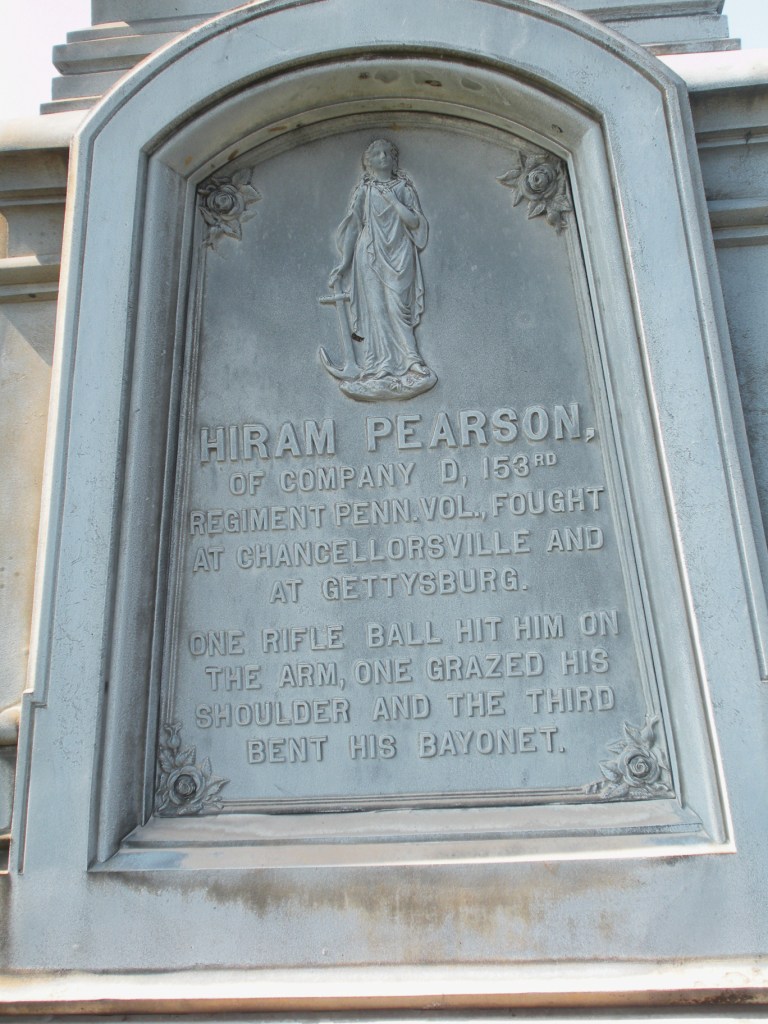
Pearson was in the 153rd PA, in the same regiment as my g-g-g-grandfather John Koken.  Greenwood Cemetery, Howertown, PA

John Buffington was a Union Lt. who was awarded the Medal of Honor for gallantry in action at Petersburg, VA in 1865, as he was the first enlisted man in his division to mount the parapet of the enemy's line.  Trinity Lutheran Cemetery, Taneytown, MD

Capt. Henry Biddle of the Pennsylvania Reserves was mortally wounded at the Battle of New Market Cross Roads and died in Richmond, VA in 1862.  Also known as the Battle of Glendale, part of the Seven Days Retreat.  Laurel Hill Cemetery, Philadelphia, PA

Pvt. Francis Veasey, who died from wounds sustained during the First Division's Soissons offensive (near the Marne).  Veasey was one of 8,365 men who died or were wounded in this offensive.  Northwood Cemetery, Philadelphia, PA

Flags, Guns and Fixed Bayonets, Laurel Grove Cemetery, Port Jervis, NY

"Soldier of the war of 1776, enlisted under Washington as he passed through Taneytown."  Trinity Lutheran Cemetery, Taneytown, MD

A war not talked much about, being the only one where the US invaded a country because it wanted some of its territory.  Manifest destiny at its lowest.  St. Mathew's Evangelical Lutheran Cemetery, Bedminster, PA

David Myers, captured at the Battle of the Wilderness, died at Andersonville [Prison], aged 25 years, 8 months and 23 days. At the bottom, it says "A dutiful son and a true soldier."  Evergreen Cemetery, Gettysburg, PA

A Confederate soldier who survived the war, Elmwood Cemetery, Shepherdstown, WV

Major John Knott, Confederate cavalry who was killed at High Bridge Battlefield, VA, while leading  a charge of his regiment, aged 31.  "Man that is born of a woman is of few days and full of trouble."  ---Book of Job  Also "The voice in battle came, He started forth to hear, A mortal pierced his frame, He fell, but felt no fear."  (poetic license on James Montgomery)  Elmwood Cemetery, Shepherdstown, WV

Confederate soldier Henry Snyder died age 28 in 1864.  His widow Mary Virginia lived for 45 years without him.  Elmwood Cemetery, Shepherdstown, WV

Henry Loyns was part of the Stonewall Brigade.  It is highly possible that he came out of the woods at Chancellorsville and ambushed Grandpa Koken, causing Koken and companies to run in the opposite direction.  Elmwood Cemetery, Shepherdstown, WV

Fairview Cemetery, Middletown, NJ

I forget sometimes that they have been around since 1790.  St. Peter's Episcopal Cemetery, Perth Amboy, NJ

Cold Spring Presbyterian Cemetery, Cold Spring, NJ

Doylestown Cemetery, Doylestown, PA

Another resident of Flanders Field, memorialized here with his parents.  Glenwood Cemetery, West Long Branch, NJ
 
Grand Army of the Republic fraternal member (tho he was in the Navy), Fairview Cemetery, Middletown, NJ
 
Another member of PA 153rd, Lower Saucon Christ Lutheran Cemetery, Hellertown, NJ

Symbol in zinc, Paupack Cemetery, Paupack, PA

GAR Civil War Veteran's marker, Lower Saucon Christ Lutheran Cemetery, Hellertown, PA
 
The 2nd GAR post organized in the US, Mount Hope Odd Fellows Cemetery, Philadelphia, PA

A Comrade of George H. Thomas GAR Post, No. 5, Chicago, IL.  Major General George Thomas was the "Rock of Chickamauga," and his defense there saved the Union Army from being completely routed.  He was a Virginian but stayed with the Union.  He is buried in Troy, NY.  Mount Pleasant Cemetery, Newark, NJ

U.S.G.P. stands for Ulysses S. Grant Post.  Mount Pleasant Cemetery, Newark, NJ

GAR Kearney Post 55, William Penn Cemetery, Philadelphia, PA
  
Glenwood Cemetery, West Long Branch, NJ

GAR Post #8 in US, Northwood Cemetery, Philadelphia, PA

A member of GAR Post 18, Northwood Cemetery, Philadelphia, PA

Woodlands Cemetery, Philadelphia, PA

Zinc representation of GAR symbol, Union Cemetery, Blakley, PA

West Long Branch United Methodist Cemetery, West Long Branch, NJ


Ladies Auxiliary of United Spanish War Veterans, Mount Pleasant Cemetery, Newark, NJ

Zeilin was a Marine, "Into thy hands, I commend my spirit, for thou hast redeemed me, O Lord."  Zeilin's father Jacob was the 7th Commandant of the Marine Corps (highest ranking officer in corps and a member of the Joint Chiefs of Staff).  Laurel Hill Cemetery, Philadelphia, PA


When they thought WWI was the only World War....Laurel Grove Cemetery, Port Jervis, NY


1st Lt. G.M. Harris died age 27 of wounds received in an engagement with the Modoc Indians at the Lava Beds in California in 1873.  The Modocs killed many emigrants using the Oregon Trail, and the US govt forced the Modocs onto a reservation with the Klamath tribe.  There was not enough food on the reservation and the Modocs left to reclaim their lands in Oregon and Calif.  In Nov. 1872, the US Army was sent to force them back, and the Modoc escaped to what is now the Lava Beds National Monument.  A band of about 50 warriors held off 3,000 Army troops for several months.  In June 1873, the Modocs gave themselves up.  The US govt executed some of the Modoc leaders and sent the rest to Indian lands in Oklahoma.   Later, they were given permission to return to their own lands in Oregon.  Laurel Hill Cemetery, Philadelphia, PA

 
Sheldon was a member of the 9th GAR post, Lynn Cemetery, Lynn, PA


Another naive marker, the only world war, Maple Grove Cemetery, Pleasant Mount, PA

Mauch Chunk Cemetery, Jim Thorpe, PA

Memorial to Frederick Schlicher, died in France.  I wonder if he is buried here?  New Goshenhoppen Union Cemetery, East Greenville, PA

St. Peter's Episcopal Cemetery, Perth Amboy, NJ

I am not sure if this is the grave of a military musician or a civilian one.  Isaac S. Gerhard was born about 1842, died 1894.  New Goshenhoppen Union Cemetery, East Greenville, PA

I have only seen these in NJ.  I wonder if veterans' groups in PA have made sure veterans have markers that state either WWI or II?  WWI Signals Corps member, in the Telegraph Battalion, Glenwood Cemetery, West Long Branch, NJ

,
A portion of the monument to Commodore David Porter (1780-1843), the first person buried in the Woodlands Cemetery, Philadelphia.  He started his maritime career at age 16, and at age 18 was a midshipman on the USS Constellation.  He was a POW in Tripoli for 2 years during the Barbary Wars, captured 3 ships from the pirate Jean Laffite, adopted and raised David Farragut, (who became the first admiral of the US Navy), and commanded the USS Essex during the War of 1812.  He was court-martialed for invading Puerto Rico to rescue a fellow commander ("unsanctioned excessive naval action").  So he resigned and joined the Mexican Navy, only to be asked by President Jackson to serve as US Ambassador to Turkey, which Porter did until he died.  (Now THAT is an obituary)  Woodlands Cemetery, Philadelphia, PA

Frank Shaffer died in 1898 in Lexington, KY while serving his country in the Spanish American war, aged 19.  He had entered the service in July and died in Division Hospital in September of typhoid fever.  Lower Saucon Christ Lutheran Cemetery, Hellertown, PA

Mount Pleasant Cemetery, Newark, PA

Lt. Frederick Compton, Light Cavalry, killed at the 2nd Battle of Bull Run, aged 25. Mount Pleasant Cemetery, Newark, NJ

Mount Pleasant Cemetery, Newark, NJ

Corporal Seely most likely died during the Spanish American War.  Fairview Cemetery, Middletown, NJ


Laurel Hill Cemetery, Philadelphia, PA

Joseph Reynolds was wounded at the Battle of Spotsylvania, died aged 19.  West Laurel Hill Cemetery, Bala Cynwyd, PA

George Jago died July 15, 1863, aged 28.  Possibly from wounds suffered at Gettysburg a few weeks earlier?  "The tired soldier bold and brave now rests his weary feet.  And the to shelter of the ground, George made his last retreat."  Zion Lutheran Cemetery, Flourtown, PA

"Fear not that ye have died for naught, the torch ye threw to us we caught.  Ten million hands will hold it high, and freedom's light shall never die.  We've learned the lesson that ye taught in Flanders Field."     New Goshenhoppen Union Cemetery, East Greenville, PA
 Hmm....No, if we had really learned the lesson, there'd be no more wars.  But thanks to all service personnel that sacrifice every day for the United States of America.  God bless you and keep you safe and bring you home. Preferably vertically and not horizontally.  THANK YOU FOR YOUR SERVICE!!!!

Uh, yeah, in case you needed a close up of that gun.  :)


Tuesday, November 6, 2012

Mothers, Boys, Doctors and Ministers: Death Remembers Them All


Hazleton Cemetery, Hazleton, PA


The following symbols show up mostly not on the tombstones themselves, but on the metal plaques anchored in the ground next to them.  And they are from the early 20th century, as opposed to the 19th century, but the stories behind them are interesting to me nonetheless.  (Once we get past 1930, I pretty much zone out---too recent---but anything before that will hold my interest.)


A Mother’s Love

The Gold Star Mothers is an organization founded by Grace Darling Seibold in Washington, D.C. after WWI.  Her son George Seibold volunteered in 1917 after the United States entered the war, and he served with the British Royal Flying Corps (the United States did not have an air force at the time).  His mother Grace corresponded regularly with him and served her country by visiting wounded serviceman who had been returned home to local hospitals.  Then George left for combat duty in France; the correspondence stopped.   

There was no word from George until October 1918, when George’s wife received a box with her husband’s effects in it.  He had been cited for bravery in France, and lost his life in August in an air fight.  His mother Grace worked through her sorrow by continuing her visits to wounded soldiers and also by organizing a group of mothers who also had lost sons in the war.  In 1928, the group officially organized as American Gold Star Mothers, Inc., so named because of the custom of families of servicemen hanging banners in their windows with blue stars for living servicemen and gold stars honoring those who had lost their lives.  The organization still operates today.

American War Mothers is another organization started in 1917 for mothers who have children who have served or who are serving in the armed forces during conflicts.  They received their Congressional charter in 1925, three years before Congress granted a charter to Gold Star Mothers.  They were also organized in Maryland, and the original charter was only for mothers who had children who had served in WWI.  Congress changed their charter after WWII saw new mothers sending children off to war.


Lake Winola Cemetery, Lake Winola, PA

Dalton Jewish Cemetery, Dalton, PA

I didn't find anything specific on this symbol, but I would guess it was similar?? Freeland Cemetery, Freeland, PA

Belfast Union Cemetery, Belfast, PA


Instilling Values in Boys

The Boy Scouts turned 100 in 2010, and in those 100 years, more than 110 million American males have been members of the Boy Scouts of America (BSA).  William D. Boyce, a publisher from Chicago, brought the idea of a youth scouting organization back with him from London after he had been lost on a foggy street and had been led to his destination by a Boy Scout who refused a tip, stating he was doing his good turn for the day.  Boyce incorporated BSA when he returned in 1910, and then partnered with several other heads of youth movements to combine their efforts.  The organization’s management was turned over to the YMCA originally, but then the BSA took back the reins and began spreading on its own throughout the United States.  The 1910 motto was to “teach patriotism, courage, self-reliance, and kindred values.”   

Carversville Cemetery, Carversville, PA

Carversville Cemetery, Carversville, PA

Greenwood Cemetery, Nazareth, PA

Mount Zion Cemetery, Pottsgrove, PA

A very interesting memorial to a local Boy Scout troop leader, St. Peter's Episcopal Cemetery, Perth Amboy, NJ


St. Peter's Lutheran Cemetery, North Wales, PA

Sunnyside Cemetery, Tunkhannock, PA

Medical Malpractice
The caduceus is recognizable to many as a symbol of the medical profession.  And yet, (I just learned this!), it’s incorrect, and the fault may lie with the U.S. Military.  The caduceus, a winged staff with two serpents entwined around it, was a Greek symbol of Hermes, the god of commerce, eloquence, negotiation, and trickery.  The Greek god of medicine and healing was Asclepius, and his symbol was similar to that of Hermes, but consisted of a simple rod, sans wings, and a single snake entwined around it.  Scholars think the early linking of the caduceus with medicine, as opposed to the rod of Asclepius, may stem from the association of Hermes with early chemistry and alchemy. 


Caduceus

Rod of Asclepius
 Another theory stems from Hermes usually being associated with merchants and messengers (who needed eloquence and negotiation---think of the phrase “Don’t shoot the messenger!”).  Merchant ships in the 16th and 17th centuries flew flags with a caduceus on it to demonstrate their neutrality during naval wars, so they could pass unmolested past war ships.  Though it was used as early as 1871 by the U.S. Surgeon General, in 1902, the caduceus was formally adopted by the U.S. Army Medical Department.  The department claimed that was because of the caduceus' association with those neutral merchants, as wartime medical personnel are considered noncombatants.  The Army also pointed out that the majority of the Medical Department personnel are not physicians (think of M*A*S*H).    

The American Medical Association even used the caduceus as its symbol for a time, but in 1912, adopted instead the rod of Asclepius.  And because of much debate (enough eloquence and negotiation to make Hermes proud), the medical branches of the U.S. Military have recently redesigned logos that feature Asclepius’ rod and not that of Hermes.  


Laurel Hill Cemetery, Philadelphia, PA

Doylestown Cemetery, Doylestown, PA
Evergreen Cemetery, Gettysburg, PA
Fairview Cemetery, Middletown, NJ

Indian Orchard Cemetery, Indian Orchard, PA
Rosedale Cemetery, Montclair, NJ
St. Luke's UCC Cemetery, Dublin, PA

Reaching to Preach

The United Methodist Church traces its origins back to John Wesley and a small group of Oxford students within the Church of England, who met to focus on a methodical study of the Bible.  Wesley and his “Methodist” friends journeyed to colonies, specifically Georgia, to teach the gospel to the Indians, but later returned to England.  The “Methodist Way” stayed, however, and Wesley sent Thomas Coke to Baltimore to organize the American Methodists in 1784.  Wesley wanted them to stay within the Church of England, but the American Revolution severed that link.  It didn’t stop the formation of the Methodist Episcopal Church in Baltimore, however, and as the church grew, it employed circuit riders, some who were laymen, to travel by horseback and preach the gospel to rural America and establish churches.  By 1844, 4,000 circuit riders had helped Methodism become the largest Protestant denomination in the U.S.  In the next one hundred years, circuit riders hung up their saddles and settled down in Methodist churches across the country.  


Stroudsburg Cemetery, Stroudsburg, PA

Dunmore Cemetery, Dunmore, PA

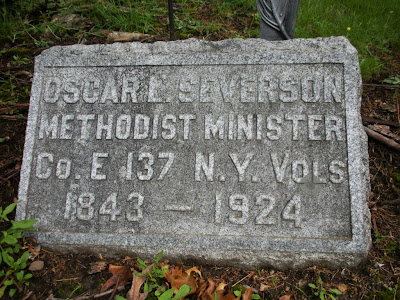
The markers above Oscar Severson's grave (last photo), Dunmore Cemetery, Dunmore, PA

Darling Cemetery, Honesdale, PA

Forks Cemetery, Stockertown, PA

Old Brooklyn Cemetery, Brooklyn, PA
Canandensis United Methodist Cemetery, Canandensis, PA